
Mastering Note-Taking: Techniques Every Student Should Know
Strong notes help you stay organized, understand material more deeply and study more effectively for exams. Note-taking keeps you actively engaged with information you are listening to. You’ll also find it helps you to recall the information as well as giving you a head start on your revision resources.
This guide breaks down the most effective note-taking techniques, when to use them and how to get the most out of your study time.
1. The Cornell Method
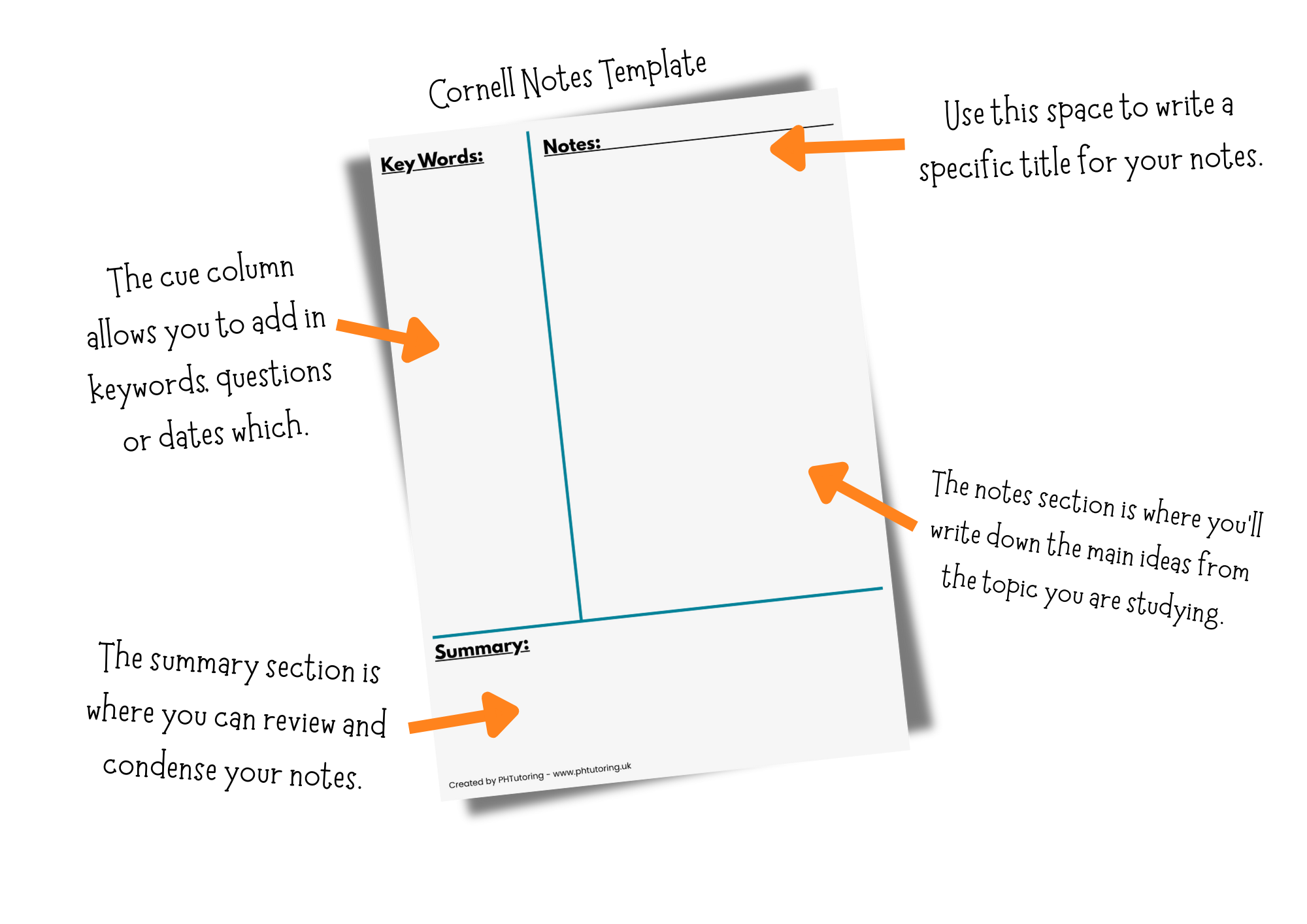
One of the most popular systems for a reason. This involves dividing your page into three sections: a notes section, a cue column, and a summary section.
The notes section is the largest part of your page and is where you’ll write down the main ideas from the topic you are studying. This might include bullet points, short sentences and diagrams if you need them. The cue column allows you to add in keywords, questions or dates which can run alongside the main notes you have made to link directly with the notes there or be completely separate. The summary section is left until the end and is where you can review your notes and then condense the main ideas into a few, short sentences. This helps to start embedding those notes into your long-term memory by getting you to think about how you can condense and rephrase the information in a new way.
Cornell notes are perfect for listening to lectures either in the classroom or revising by listening to videos. They can also be great when studying from textbooks or revision guides as it gets you actively involved instead of just reading from a page. Best of all, they encourage reflecting and reviewing the information to help you make the notes your own; the summary step can be challenging at first but stick with it as it makes a massive difference when it comes to remembering your notes.
2. Mind Mapping
A visual technique that builds connections using diagrams. Start with a central idea in the middle of the page. Branch out into subtopics, keywords, and ideas using lines, arrows, or colours. I find I use this one the most, especially when annotating quotes in English Literature as it’s great for zooming in on individual words and adding effects, themes or links. It’s also really easy to add extra memory aids by colour coding the information and links as well as adding diagrams or images if you need them.
As mind maps are perfect for brainstorming, they make for a great revision activity on their own but are also perfect for note taking especially for topics with interconnected ideas or subjects where you frequently have to delve in and explore specific ideas.
3. Bullet Points
Clean, simple, and highly structured. Bullet points are perfect for a short note or even an individual key word but you can also use them to organise a larger collection of notes.
You can start with a main topic or heading
Then add in sub-topics and more specific ideas
Include important details
And examples
Or quotes
Personally, I find this one tricky to do ‘live’ when listening to a lecture or video unless I know in advance what the main topics/headings will be. Part of the reason for that is I prefer making handwritten notes (it helps me to remember information more effectively) so it can get messy or disorganised if, for example, I want to add extra details to a sub-topic. However, it you’re making notes digitally then this isn’t really a problem and, like the previous methods, is a great way of interacting with and processing existing revision notes to boost your recall and retention.
4. The Charting Method
Ideal for comparison-heavy subjects. Create a table with columns for categories, then fill in rows as new information appears. This is a perfect method for subjects where you will be making comparisons between topics; think History timelines, comparing theories, different scientific processes or character studies.
You can combine this with bullet points to help keep the information in the columns organised and you can even add a summary at the end of each column to consolidate the information as well as giving you a quick comparison between all the different headings.
5. What to Include
So, this isn’t exactly a method but none of the previous examples are going to be much good if we don’t know what to actually put in our notes! Like any skill, effective note taking requires some practise but this is something you can easily do when listening to revision resources and guides.
Listen for key ideas as you don’t need to write down every word that is being said. Focus on including definitions and examples. It’s fine to shorten these and put them in your own words (you’re making notes after all!) but try to still include any subject specific language. Also, pay attention to what your teacher is emphasising; if they keep repeating words and phrases then they are probably important.
Use abbreviations to speed things up. There are several commonly used symbols such as e.g. instead of ‘for example’ but it’s ok to use your own too; these are your notes so it’s ok if you’re the only one who understands them.
Add a summary to your notes. Some methods, like Cornell notes, include this as part of the process but you should always aim to create a small snapshot of any notes you create. There are a lot of practical benefits to doing this especially when it comes to helping you to remember the information when you need it.