
Essentials for Creative Writing in GCSE English Language
Even the most creative students can find improving their grades challenging when it comes to writing for GCSE English Language. In this article, we’re going to cover some of the simplest, yet most effective ways of adding marks in your creative writing tasks.
The Importance of Planning
An absolutely essential step when writing but also probably the most overlooked by so many students. Planning is crucial for any extended writing task but here’s the real reason students often forgo a plan and dive straight into writing: they don’t know how to plan effectively and they don’t understand the impact it has on their grade.
Some plans I’ve seen have just been the student writing the first paragraph of the answer and then writing it out again! So what is a useful plan? It doesn’t need to be much on paper but the impact is huge. Here was my plan for writing this article:
· Intro
· Planning
· Inspiration
· Content
This probably doesn’t look like much but it allowed me to organise what I wanted to write about and give my ideas some structure. A lot of students might be familiar with the idea splitting their main points or topics into paragraphs and this is a plan for a non-fiction piece of writing (a blog article) which does exactly that. It can work for fiction writing too but when writing a story or description you plan instead for what each paragraph will focus on. For example, paragraph one might describe the surrounding for the setting, then paragraph two might zoom in on an important detail in the setting before shifting focus in paragraph three to describe a character. The important goal for planning is to give each paragraph a purpose so that you are starting paragraphs in the right places and each one is adding something to your answer.
What to Write About
The prompts in the questions are usually quite brief so it can be a challenge to think of enough things to write about to complete those big mark questions.
Depending on your exam board you might have one or more images given to you as inspiration. These are a great source of writing material if they are used correctly! One thing I always stress to any students I teach is that the images are just suggestions. This means you aren’t being marked on how accurately you describe the image; it’s just there as a prompt to get your imagination going. You should absolutely feel free to change things, add details, and even imagine what might be beyond the edges of the picture.
Another tip to make sure you are maximising the inspiration you can get from the picture is to annotate the image. As you’re looking at the picture for things to describe, circle or box-off the sections of the image so you know what you have used. It might sound silly but you would be amazed at how much we miss on a picture because our eyes get drawn to just a few big details and we leave lots of great opportunities to describe smaller features that help to bring our writing to life.
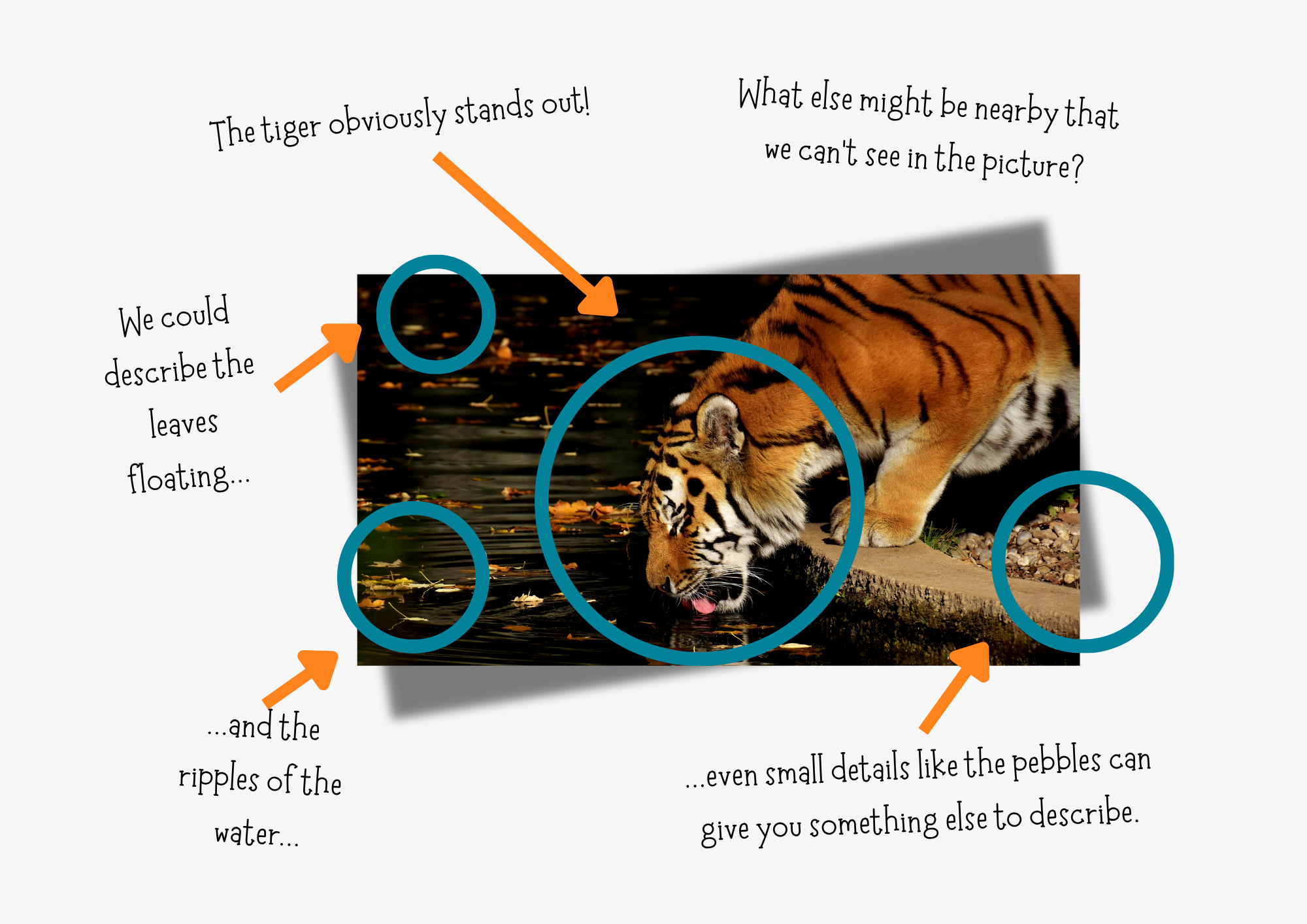
Now, if you don’t have an image in your exam and instead have a choice of story prompts, there are still ways you can find inspiration and get your creative writing off to a flying start. Practise writing detailed and vivid descriptions about things which could appear in almost any story. For example, describing the weather on a stormy day, the background noise of a busy city, or the unexpected sight of a bird flying past. No matter the story prompt, you’re ready to set the scene in a busy city during stormy weather and kick things off with a narrative hook as your character’s attention is drawn to a majestic bird in the sky. Easy!
Making Sure You Write Enough
When it comes to getting enough content into your answer, you’ll want to think about ‘layering up’ your description. One of the first areas I look at when going through feedback with my students is exactly how much they have written about each of the details they are trying to describe. Very often, we’ll notice it’s one sentence per detail. They might be fairly long and complex sentences but it makes the writing sound a bit dull and repetitive! So if we were using the picture above as an example, we’d have one sentence on the tiger, one on the leaves, one on the water, and so on. To improve it, we’ll talk about how we can add some variety by adding some extra layers to the description. So maybe the tiger gets three sentences written about it, and the leaves and water get two each. Perhaps there isn’t much else to describe about the pebbles so that still just gets one sentence but that’s fine because now we have a paragraph made up varied sentences with lots of detail being explored.
Get Writing!
Creative writing tasks on the Language GCSE have a big impact on your overall grade so it’s incredibly important to get this correct. It’s also a topic that can vary massively in how you approach it and there isn’t necessarily one correct way to do a successful piece of creative writing. There lots of fantastic writing prompt generators out there and an effective revision technique is to simply practise writing. Nobody creates a perfect piece of writing straight away so don’t worry if you aren’t 100% happy with your early drafts, just keep trying and looking for ways you can make it better or more varied. If you need more help, take look at the upcoming workshops for some extra support with your writing skills.